Headless CMS for developers. Define your content once, deliver it to your website, mobile app, newsletter and AI agents through a clean REST API.
380
Active users
8M
Annual visitors on client websites
30
Ready-made blueprints
12
Field types
About
Most teams no longer publish to a single website. The same article has to reach a site, a mobile app, a newsletter, and now AI agents and chatbots. Monolithic CMSs tie content to templates, so every new channel means copy-pasting, or an engineering ticket for each landing page change.
Diggama is a headless CMS built for developers and the content teams they work with. Developers model content with Blueprints: content types, fields and validation rules. Editors write, schedule and publish in a form they already understand. Every published entry is instantly available through a clean, token-scoped REST API that works with any front-end framework.
Around that core, Diggama ships what teams usually bolt on later: language variants, revisions, team roles, workflows that fire emails and webhooks on content changes, an MCP server for AI tools, an AI assistant, and a new AI Chatbot that answers website visitors from published content.
The product has a long lineage: Stackway in 2018, a CMS and e-commerce platform, then Webgo in 2022, focused on CMS. Diggama is its headless evolution, still in active development as new capabilities roll out.
Product timeline
Source: diggama.com2018
Stackway
First product, CMS and e-commerce combined.
2022
Webgo
Rebrand and exclusive focus on CMS.
2026
Diggama
The headless CMS, API-first, with workflows and AI.
Inside the product
Blueprints in the sidebar, the editor in the middle, and the API response it produces next to it. When an entry is saved, a workflow can trigger a deploy on the spot, with no build to run by hand.
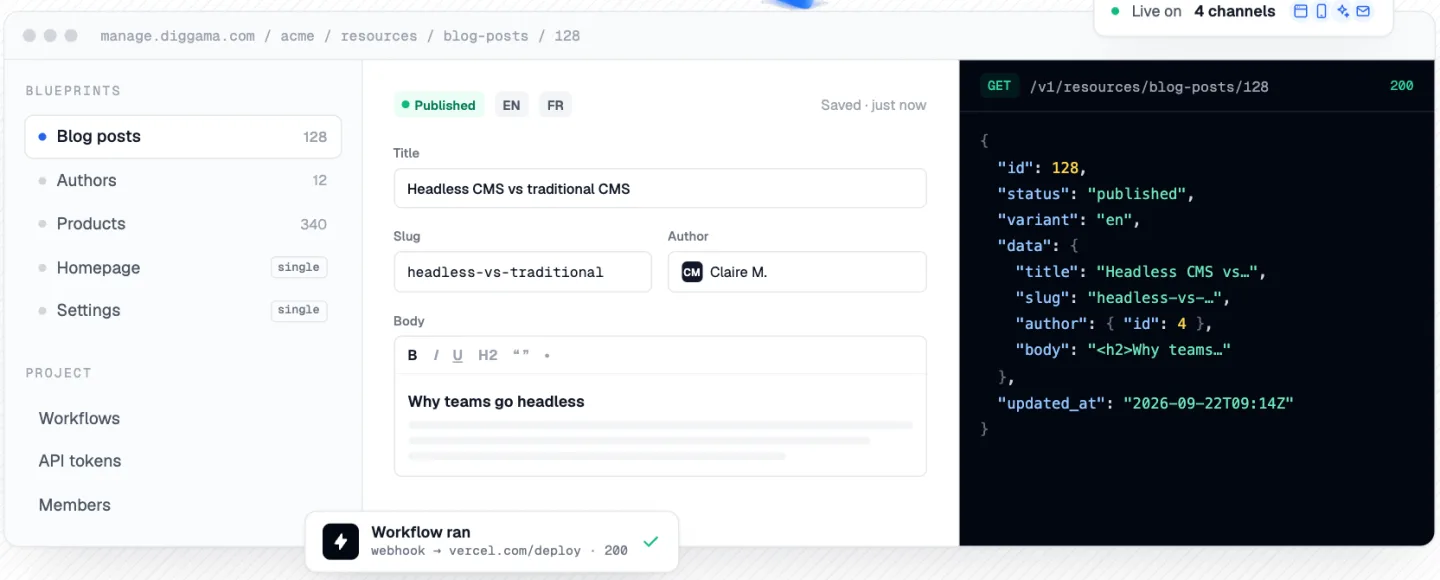
Product view from diggama.com, with the demo workspace "acme".
How it works
From an idea to a production-ready content API. No server to run, no build to trigger when an editor hits publish.
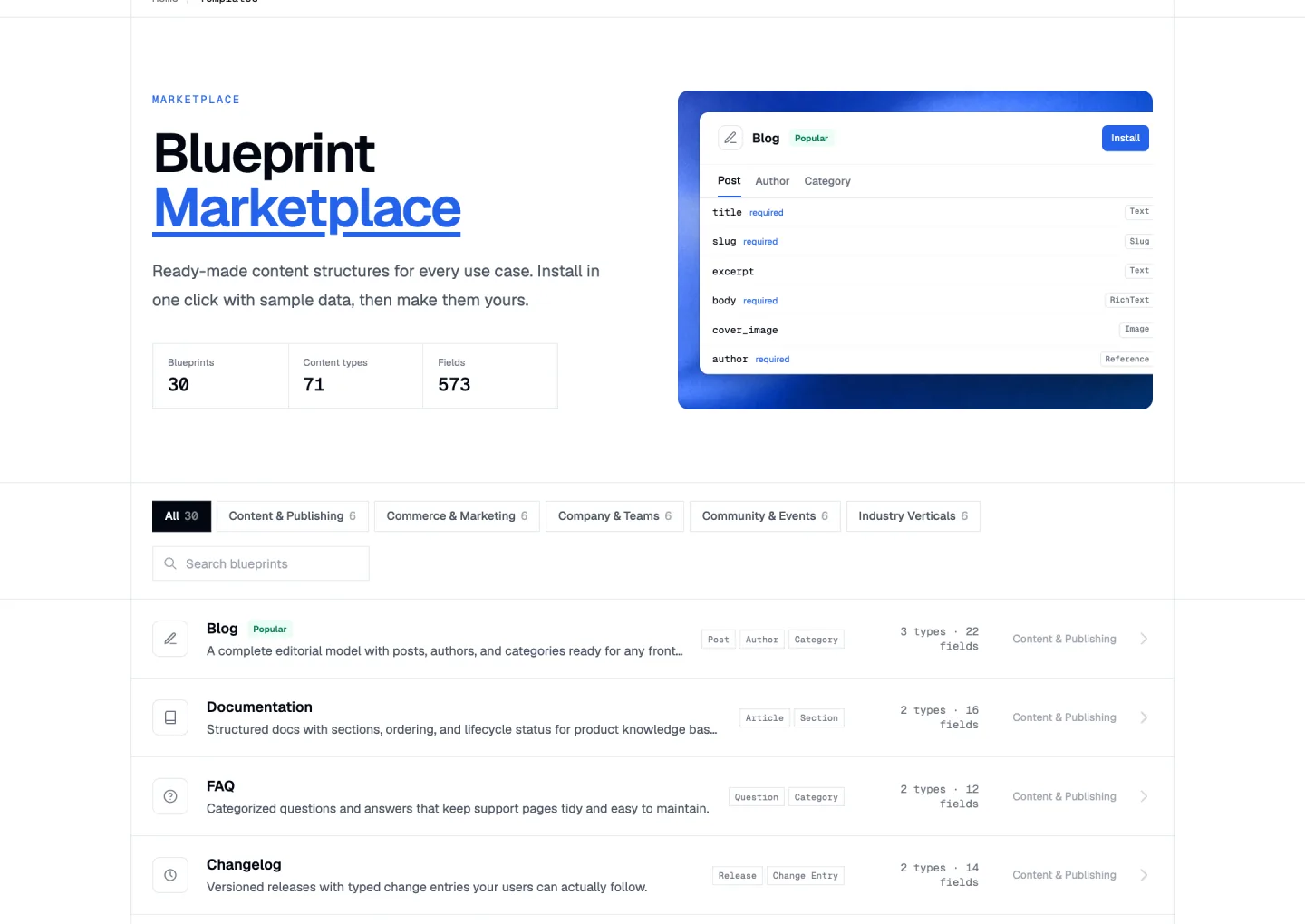
Content types, fields and validation rules. A blog, a product catalog or a homepage is modeled in a few clicks, or installed from the marketplace with sample data.
Blog posts Resource
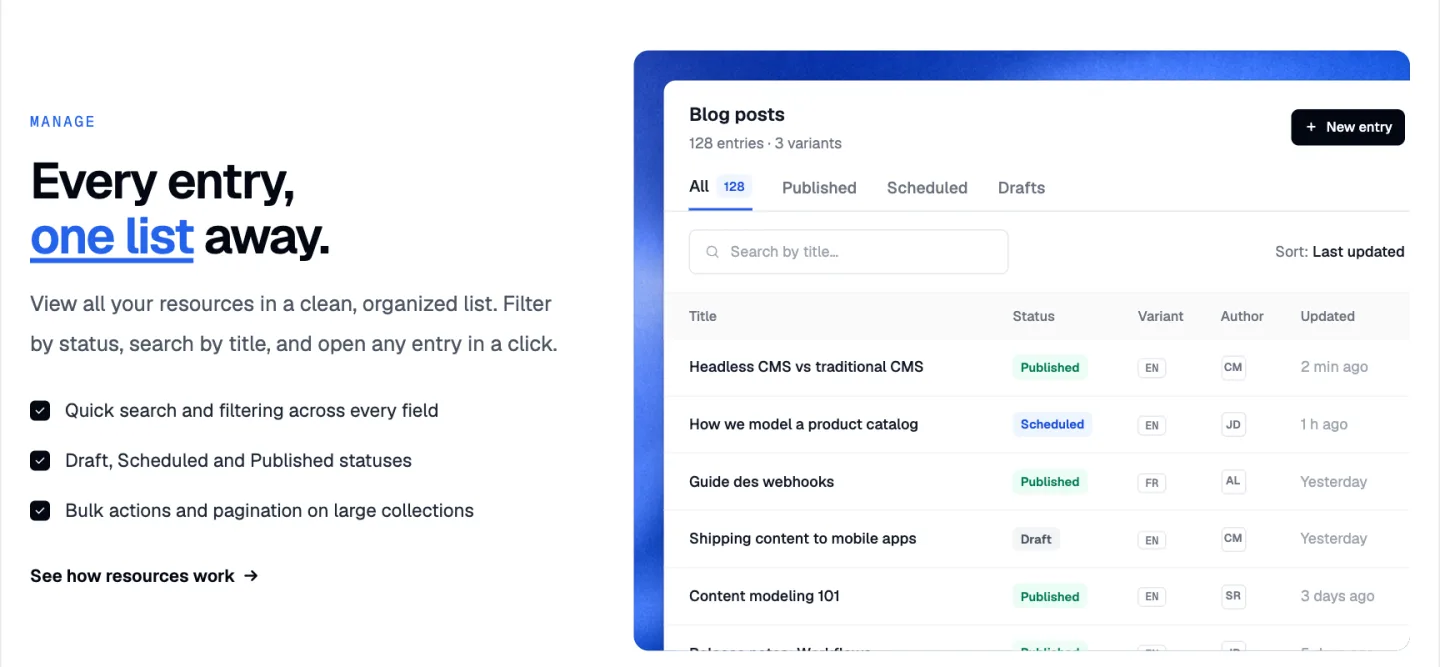
IllustrationEvery blueprint becomes a form, with the right input for each field type. The team writes, reviews, schedules and publishes, with one variant per language and every revision kept.
Entry #128
ScheduledHeadless CMS vs traditional CMS
Goes live Tue, 09:00 · by Claire M.
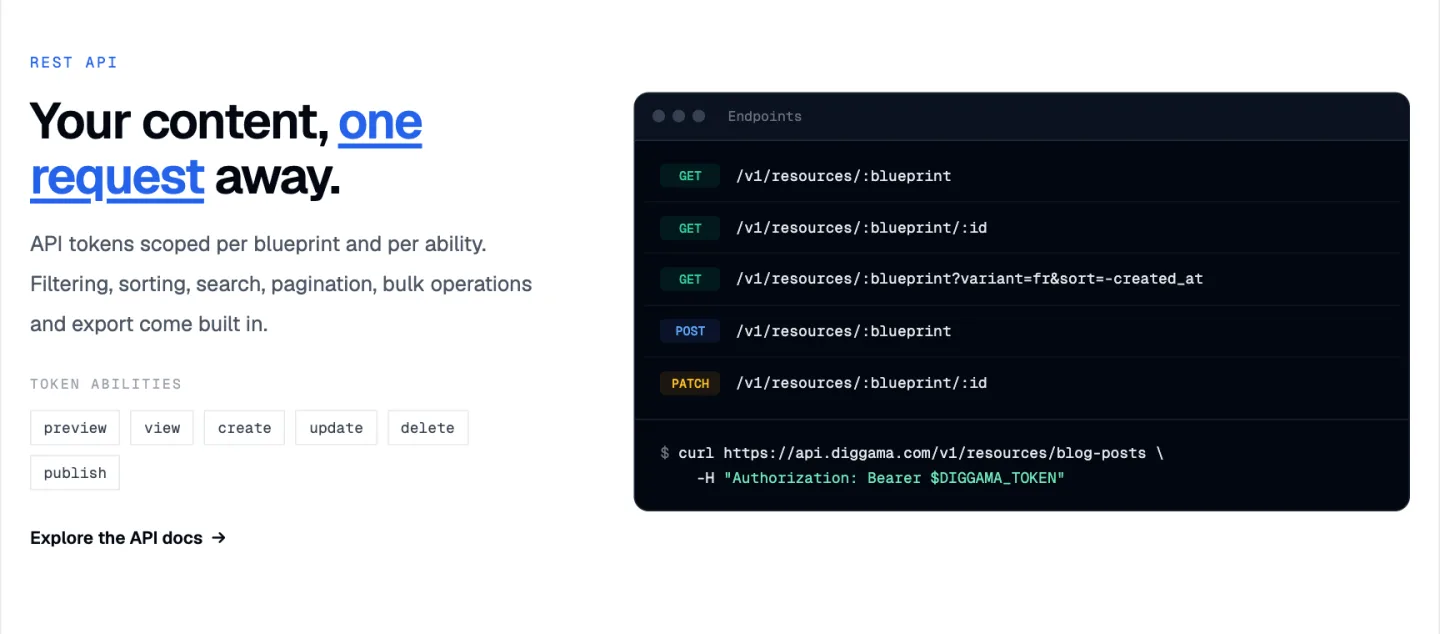
A clean REST API, token-scoped, with filtering, sorting, search, pagination, bulk operations and export built in. Works with React, Vue, Next.js, Astro or plain HTML, and with the mobile app, the newsletter or an AI agent.
Token abilities, scoped per blueprint.
{
  "data": [
    { "id": 128, "title": "Headless CMS vs…" },
    { "id": 127, "title": "Catalog…" },
    { "id": 126, "title": "Webhooks…" }
  ],
  "meta": { "total": 128, "page": 1 }
} When a resource is created, updated or deleted, a workflow checks a condition and sends an email or a webhook to any service: redeploy a static site, warn a channel, sync a tool. Editors publish, the rest follows.
Notify on publish
ActiveProduct
Write an entry once. The site, the app, the newsletter and AI tools all read the same version, the moment it is published.
Content modeling
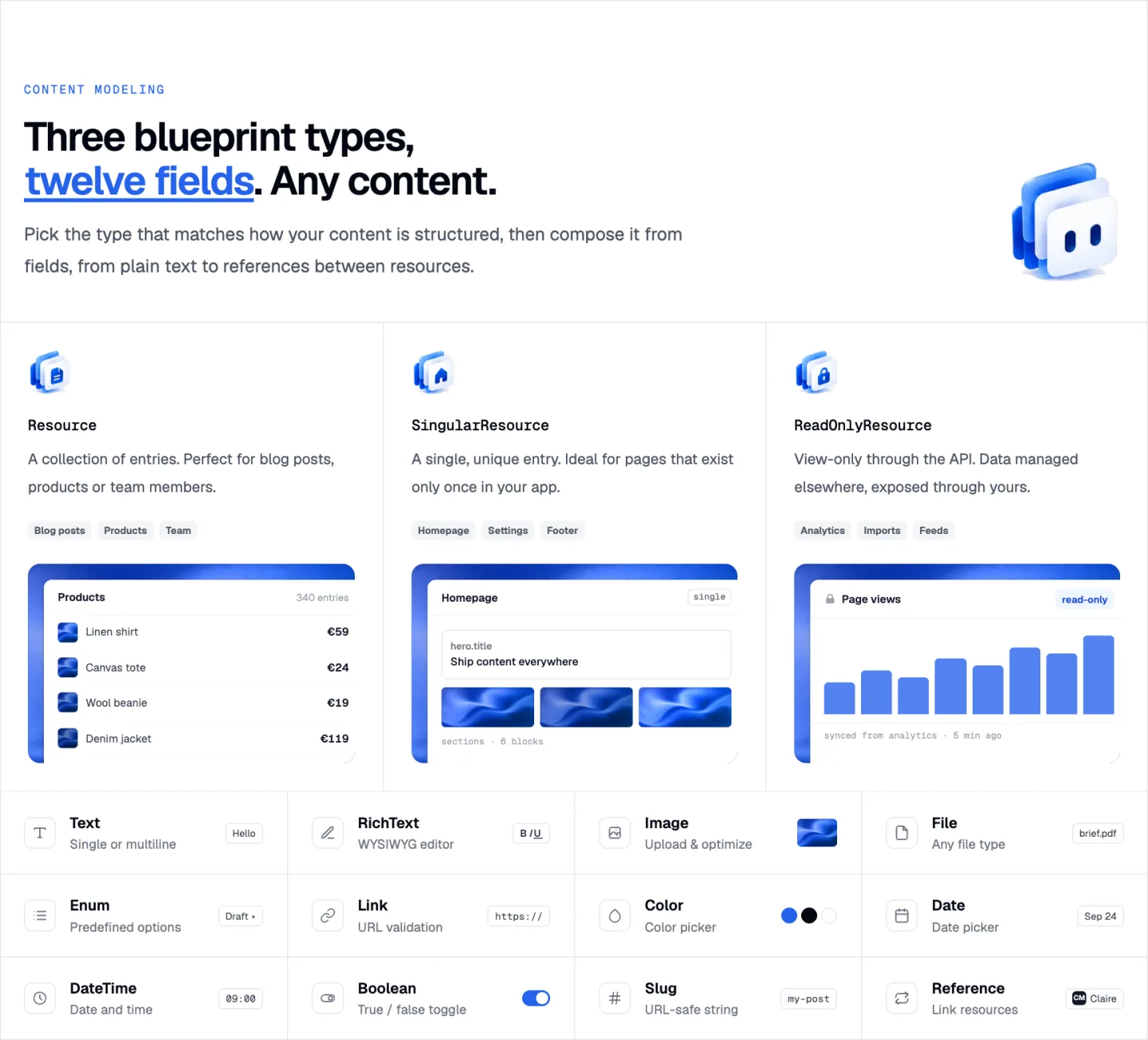
Three blueprint types and twelve field types, from Text and RichText to Enum, Color, DateTime and References between resources.
An editor for writers
Forms generated from each blueprint, auto-save, revisions, scheduling and language variants. Writers fill in content, not markup.
REST API
Token-scoped endpoints with filtering, sorting, search, pagination, bulk operations and export. No vendor lock-in on the front-end.
Workflows
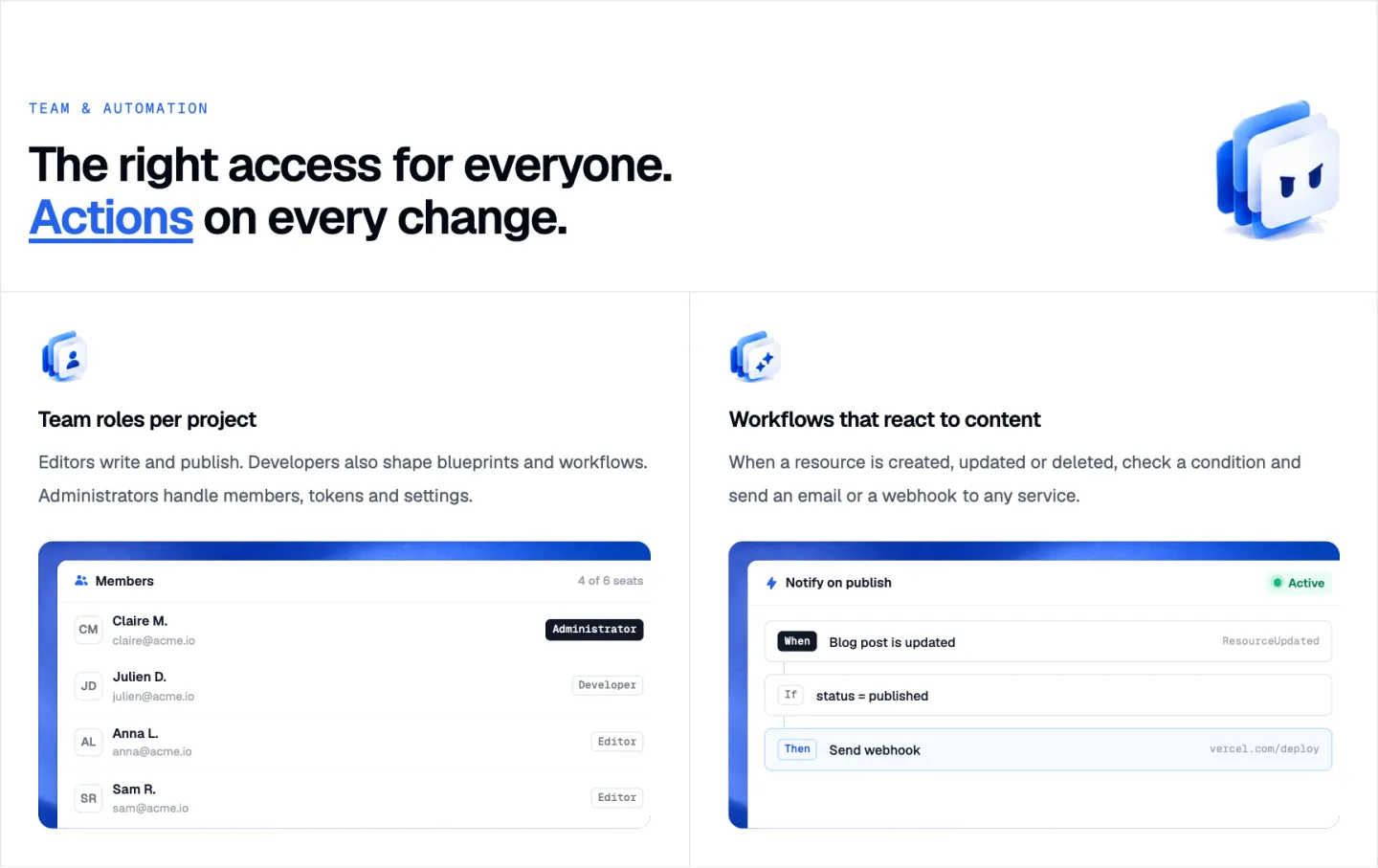
Emails and webhooks triggered by content changes, with conditions. Deploys and notifications run on their own.
Team roles
Editors write and publish, developers also shape blueprints and workflows, administrators handle members, tokens and settings.
Built for AI
An MCP server for AI tools, an AI assistant, and an AI Chatbot that answers visitors from published content, in their language.
Screens
Real captures from diggama.com, from delivery across channels to the blueprint marketplace.
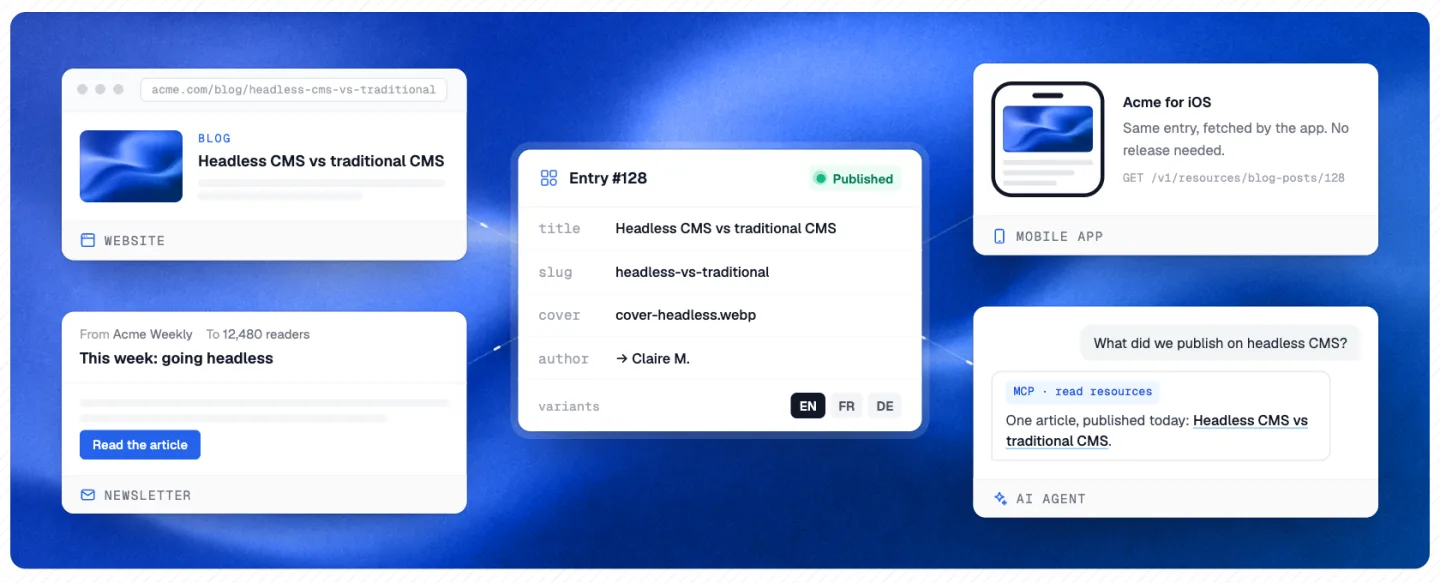
One entry, four channels: the website, the newsletter, the mobile app and an AI agent all read the same published version.
Growth
The milestones published by Diggama across its three generations of product: active users of the CMS, and annual visitors on the websites it powers.
Active users
Stackway, Webgo, Diggama
40
2018
200
2022
380
2026
Annual visitors on client websites
Across sites powered by the CMS
Customers
Several Garan companies run their content on Diggama, from crypto media publishing every week to e-commerce campaign pages. Figures below are those published in Diggama's customer stories.
Coinstancy
Fintech, crypto
10×
faster publishing
Naty
E-commerce
-80%
cost per campaign page
Quivercrypto
Crypto media
40+
articles per week
Tonaily
AI SEO content
Marketing owns the site
Legalnest
Legal tech
Customer story on diggama.com
Garan Group
Group websites
Websites, one hub
Business model
Every plan includes workflows, MCP, the AI assistant and an allowance of AI Chatbot conversations. Extra conversations are 49€ per 100 a month.
Starter
For small teams getting started.
29,90€ /month
Growth
PopularFor growing businesses and teams.
89€ /month
Enterprise
For larger teams with security needs.
249€ /month
Pricing as published on diggama.com. No credit card required for the trial.
Our relationship
Diggama was built through Garan's Startup Studio program. We co-founded and built the company alongside the founding team, providing technical execution, product design, and go-to-market support from day one.
Co-founding
Involved from day zero: the move to headless, positioning for developers and the company structure.
Product & design
Blueprint model, editor experience and the developer experience around the API and documentation.
Engineering
Our engineering team built the platform from the ground up: REST API, workflows, MCP and the AI Chatbot.
First customers
Several Garan portfolio companies run their content on Diggama, giving the product real production traffic to learn from.
Shared infrastructure for the group
Diggama is part of the toolkit Garan's companies build on: content for Coinstancy, Naty, Quivercrypto, Tonaily and Legalnest, and the group's own websites. Each new venture starts with a content API that already works, instead of rebuilding a CMS.
Whether you're building, investing, or looking for a strategic partner, we'd love to talk.