Polynesian CRM platform
01About
Naty is a CRM built in the fenua, French Polynesia, for small and medium-sized teams that want the essentials done properly: contacts and companies on one timeline, as many pipelines as they have teams, saved views, and a dashboard that shows the whole business on one screen.
Most CRMs end up as a database nobody updates. Naty takes the opposite route: on top of the CRM, AI agents read the records, write the summaries and create the follow-up tasks. Every write can wait in an approval queue, so the team stays in control of what ends up in the data.
Around the CRM, Naty bundles the tools a sales team usually pays for separately: quotes that clients accept online, hosted forms for lead capture, a scheduling page synced with Google Calendar, files with versioning and secure sharing, and email threads attached to every record. Eleven apps, one subscription, AI included in the price.
It is designed as a simpler alternative to US-centric suites like HubSpot. Prices are shown in euros and in Pacific francs, plans carry Polynesian names, and the importer reads HubSpot, Pipedrive and Salesforce exports so a team can bring its history along.
At a glance
02Inside the product
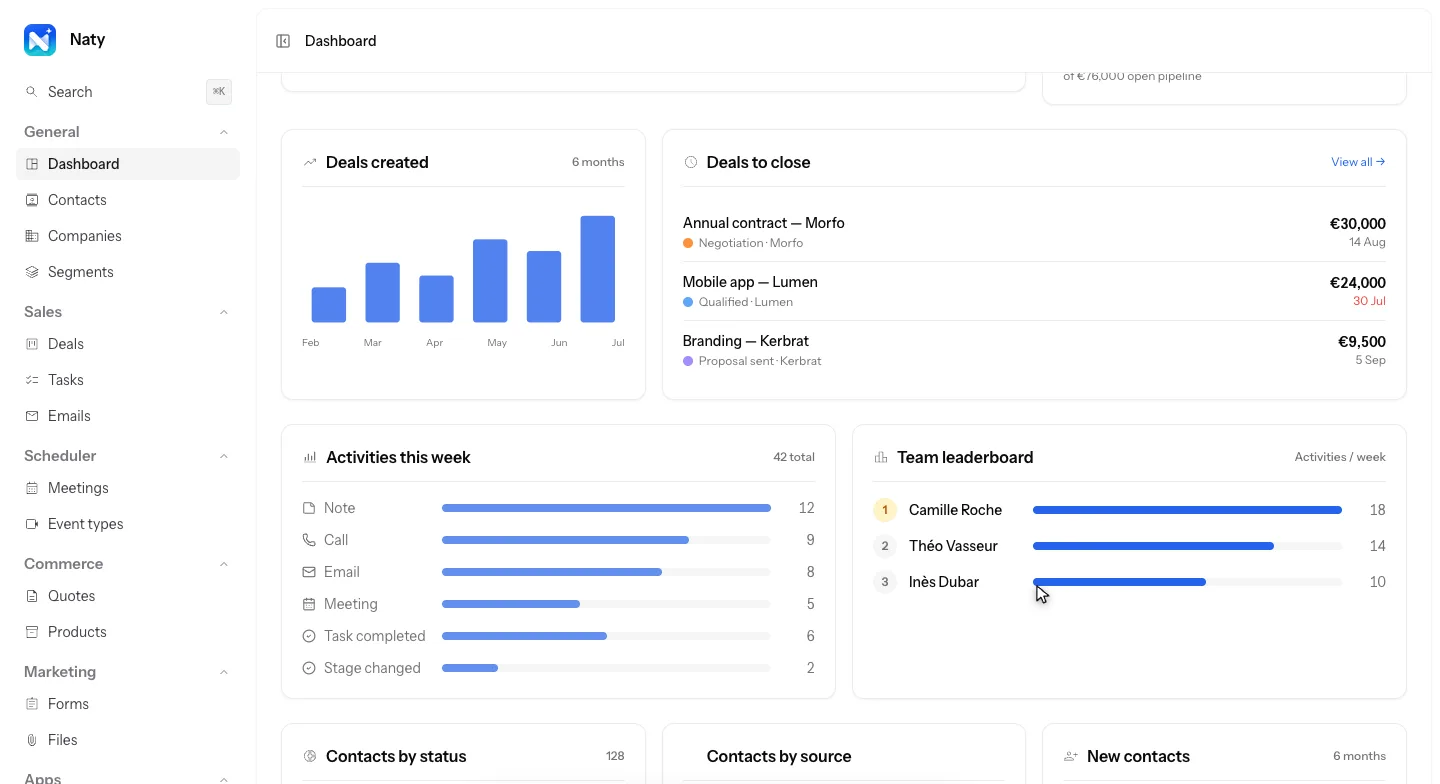
Open pipeline, weighted forecast, won this month, conversion rate, weekly activity and overdue tasks. The sidebar groups the eleven apps by job: general, sales, scheduler, commerce and marketing.
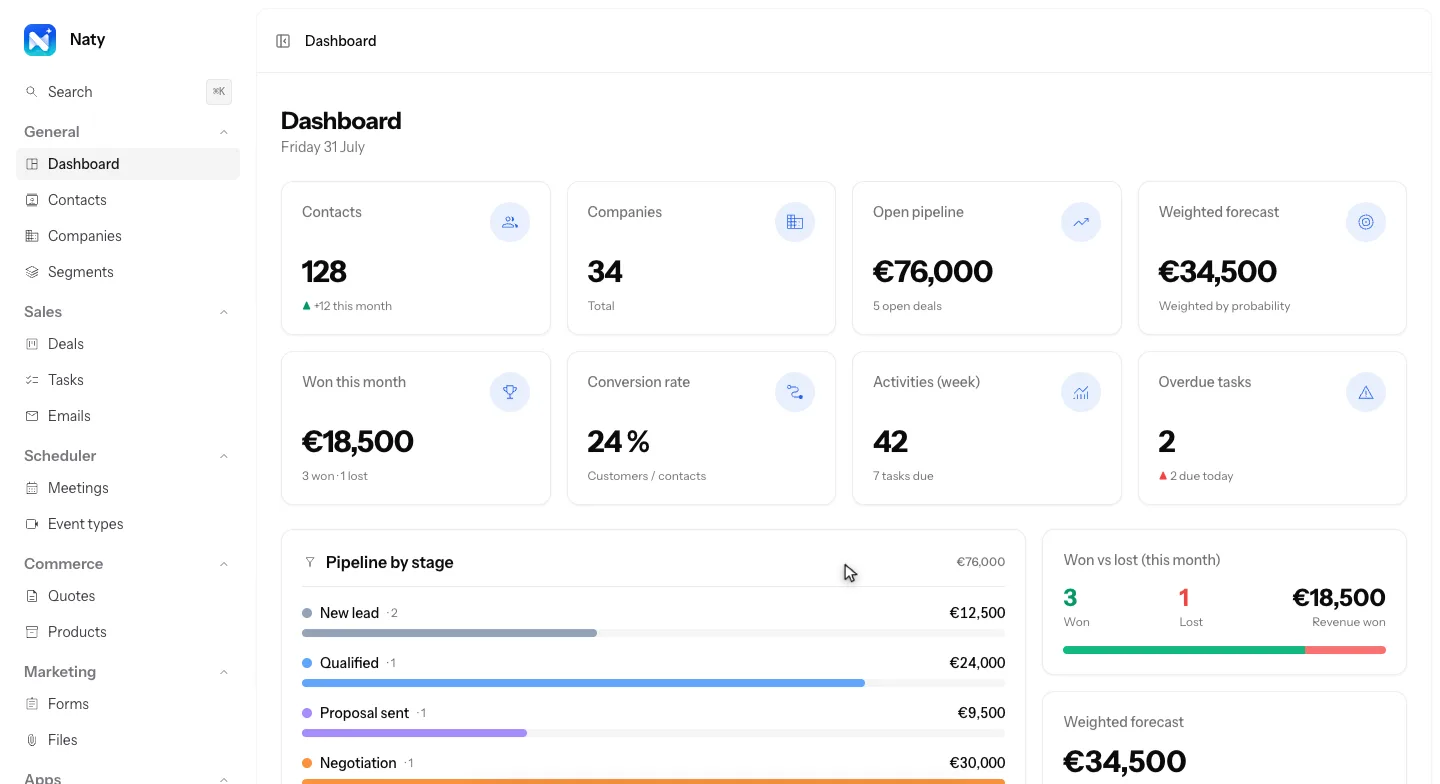
Naty demo workspace. Figures shown are sample data.
03How it works
An agent is made of four parts. It wakes up on a trigger, reads only the data it is allowed to read, follows your instructions within a token budget, and writes only the actions you ticked. Each run is a single model call with a context you choose.
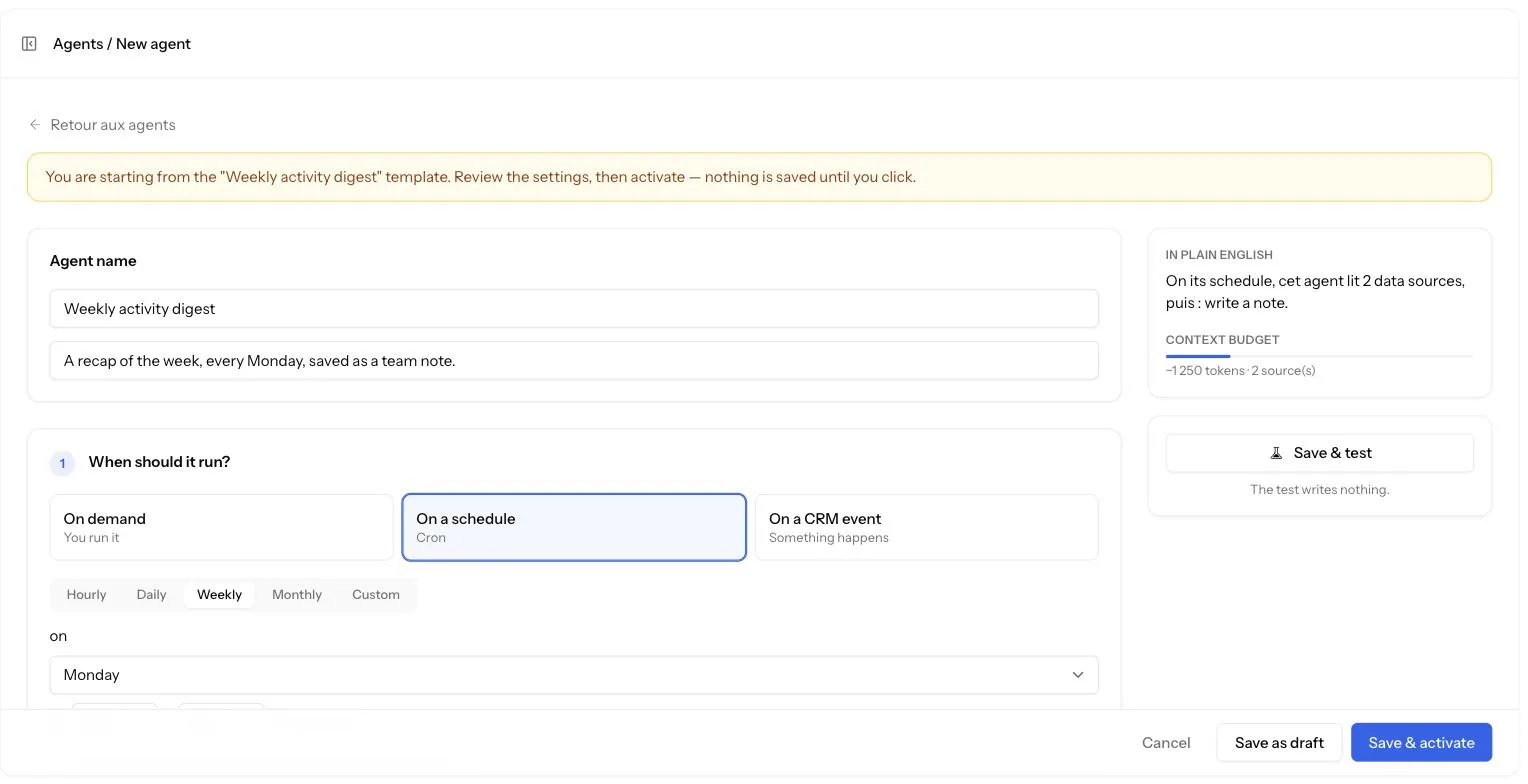
Three trigger types. A schedule with its own timezone and a minimum interval of 15 minutes, with catch-up for missed runs. A CRM event, with configurable rate limiting. Or a manual run, for tests and urgent cases.
Agents / Stale deal nudges
Illustration
When should it run?
On demand
You run it
On a schedule
Cron
CRM event
Something happens
Recent CRM events
contact.createdLéa Fontaine, Atelier Nord
form.submittedWebsite form
deal.stage_changedBranding, Kerbrat
booking.createdDiscovery call
deal.wonAnnual contract, Morfo
Eight context providers, picked one by one. The agent never sees the whole database, only the slices you select, from the record that triggered it to a digest of stale deals. While you configure it, a panel shows how many tokens that context will cost.
The model is only called when there is data to process, which keeps credits for useful runs.
What should it look at?
Illustration
In plain English
Every Tuesday at 09:00, this agent reads 3 data sources, then creates tasks and adds a tag.
Context budget
~1,820 tokens · 3 sources
Six possible writes, on the record that triggered the run or on records the agent resolved from its sources. You set a maximum number of actions per run, and pick the model and budget agent by agent.
Need a predictable outcome instead? An agent can hand off to a deterministic automation: the agent decides, the automation executes.
What should it do with that?
Illustration
Create a note
Dated and attributed, on the record
Create a task
With assignee and due date
Update a field
Native or custom
Add a tag
"stale" on idle deals
Send a digest by email
To chosen recipients
Trigger an automation
Bridge to the deterministic engine
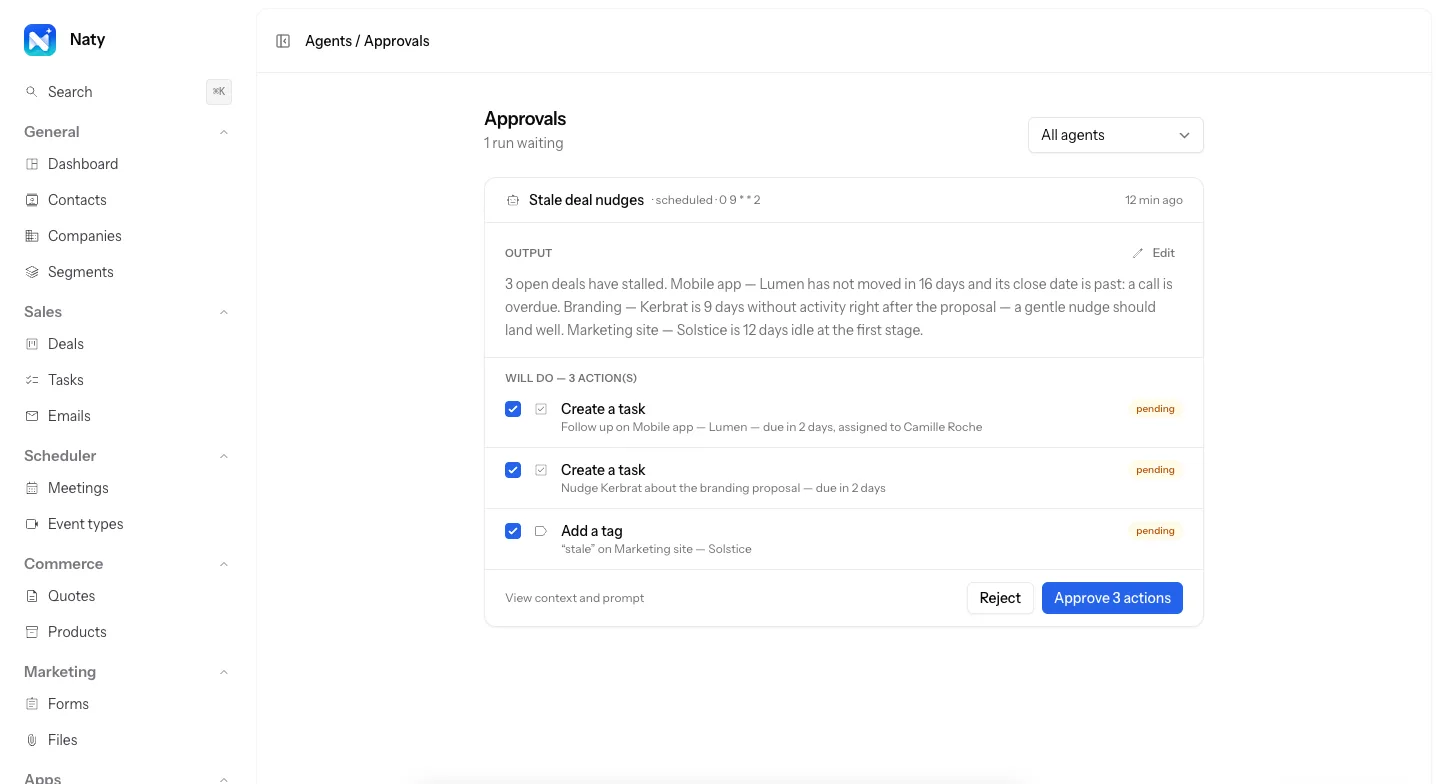
Human approval switches on agent by agent. Proposed writes wait in a dedicated queue with a configurable expiry, and the right to approve is a separate permission from the right to configure. Try it on the right.
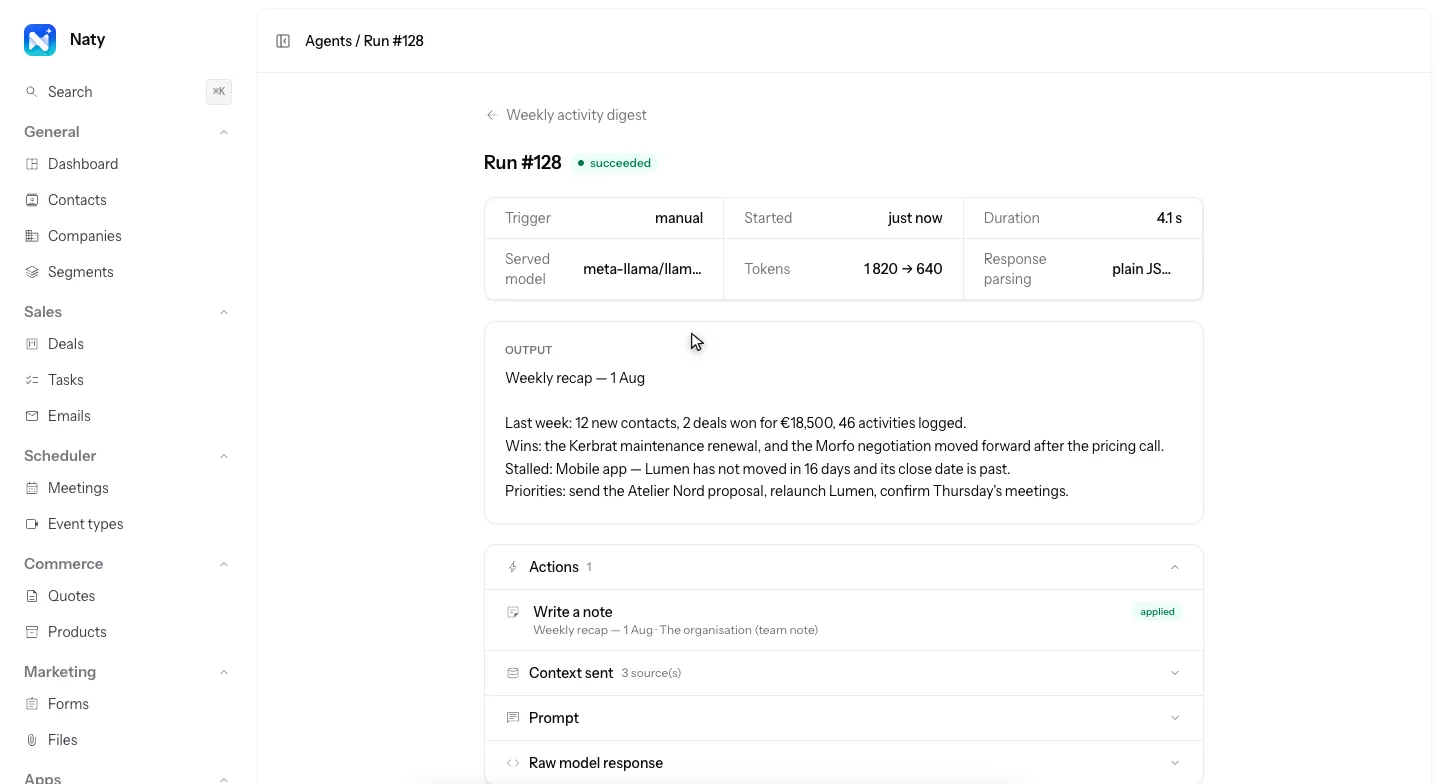
Each run keeps its full history: context read, model response, actions applied and errors.
Agents / Approvals
Illustration
Stale deal nudges · scheduled
12 min ago
Output
3 open deals have stalled. Mobile app, Lumen has not moved in 16 days and its close date is past. Branding, Kerbrat is 9 days without activity after the proposal.
Create a task
Follow up on Mobile app, Lumen
Create a task
Nudge Kerbrat about the proposal
Add a tag
"stale" on Marketing site, Solstice
04Product
The CRM basics, done properly, plus the modules a sales team usually buys on the side. The workspace is modular: it only shows the apps you actually use.
Pipelines
Multiple pipelines, drag-and-drop Kanban or list, a probability per stage, a running total per column and won or lost triggers. Deals are multi-currency.
Contact record
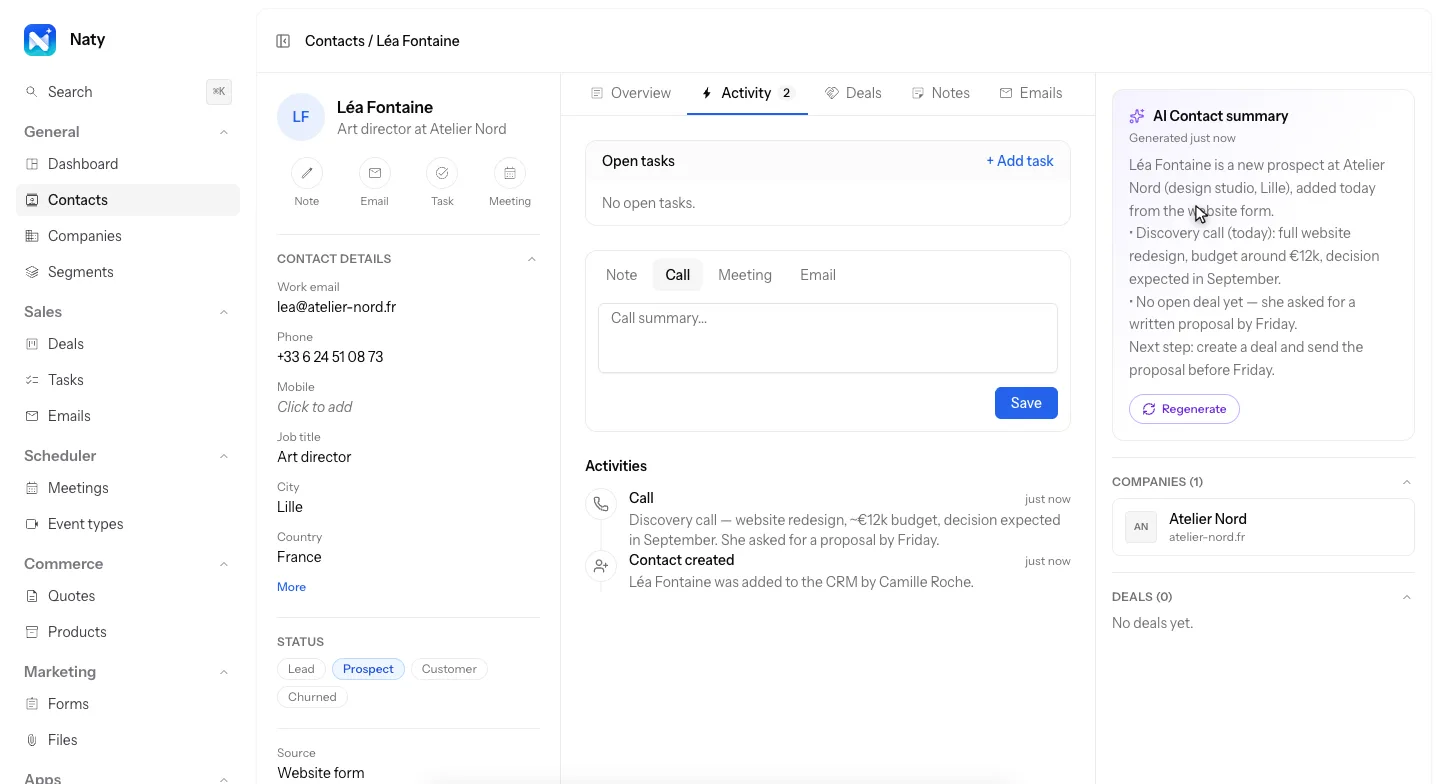
Calls, notes, emails and meetings on one timeline, with a stored AI summary, linked tasks and deals, tags and seven types of custom fields.
Views and segments
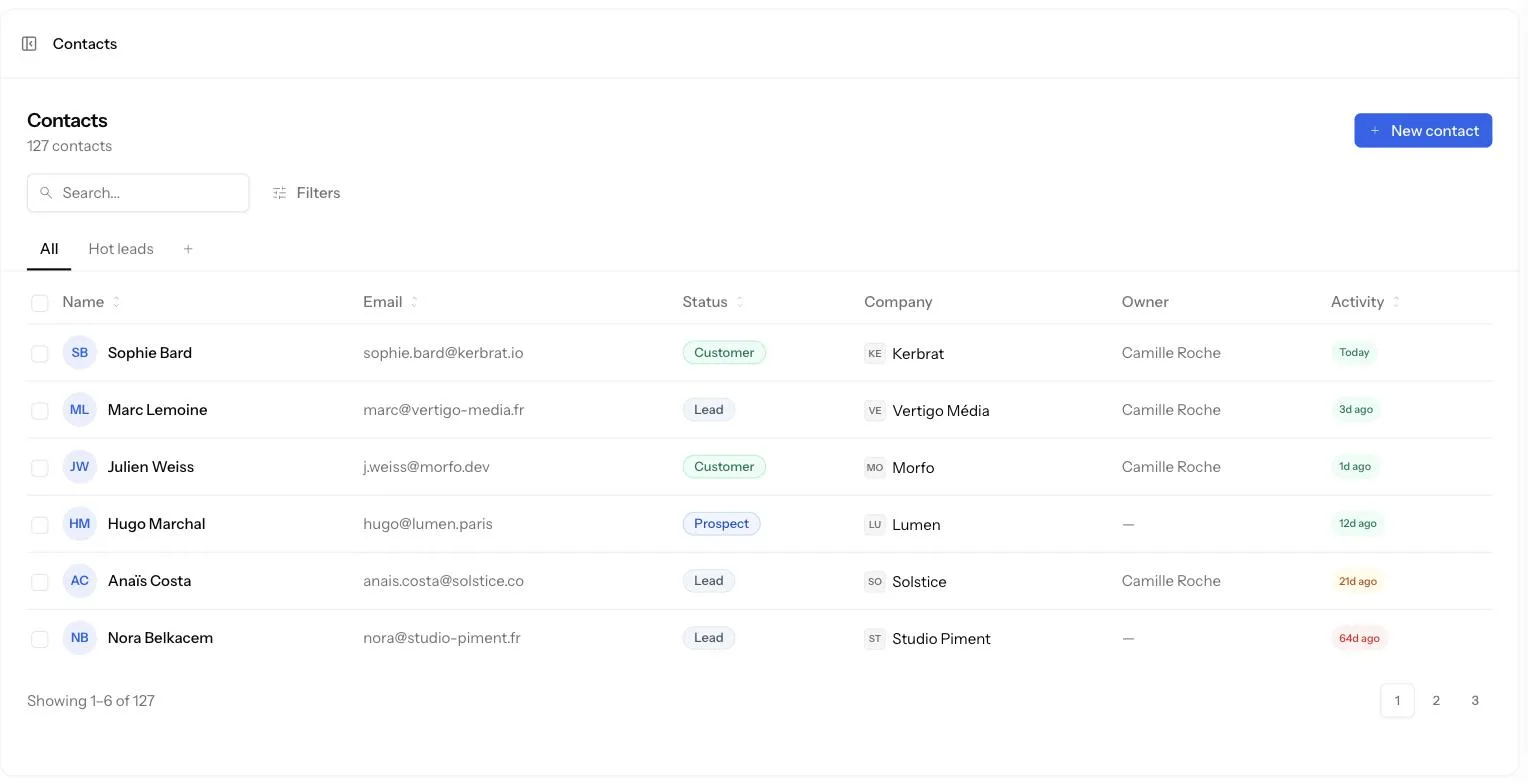
Nested AND/OR filters over native and custom fields, saved and shared in one click. Dynamic segments re-evaluate continuously and agents can use them.
Quotes
A product catalogue, an editor with VAT per line and discounts, and a public page where the client accepts or declines. The answer lands in the CRM.
Forms and scheduling
Hosted lead-capture forms that feed the CRM directly, and booking pages synced with Google Calendar, with a Google Meet link on both sides.
Files and email
A file browser with versions, trash and protected share links with expiry and view tracking. Email via IMAP, with threads on every record.
05Screens
Real captures of the Naty app, from the sales pipeline to the agent run log.
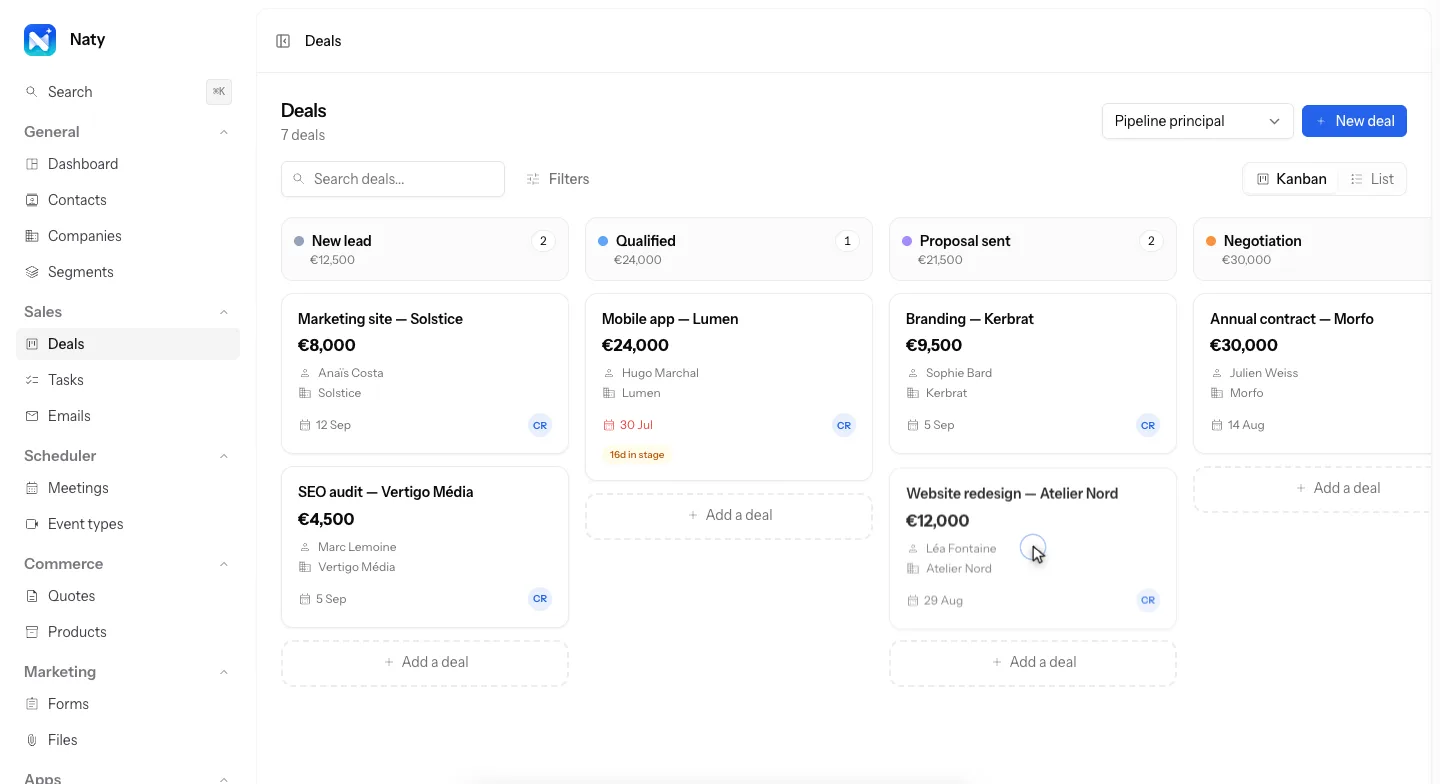
Kanban pipeline: configurable stages, a running total per column and a flag on deals that sit too long in a stage.
06Dashboard
The dashboard computes what a sales lead checks every Monday, without a spreadsheet: pipeline value, the forecast weighted by stage probability, deals won and lost, and where the activity is going.
Open pipeline
€76,000
5 open deals
Weighted forecast
€34,500
Weighted by probability
Won this month
€18,500
3 won · 1 lost
Conversion rate
24%
Customers / contacts
Deals created
6 months
Pipeline by stage
€76,000
3
Won
1
Lost
€18,500
Revenue won
Activities this week
Notes, calls, emails, meetings, completed tasks and stage changes all land on the timeline, and roll up into a team leaderboard.
Sample data, from the Naty demo workspace.
07Agent store
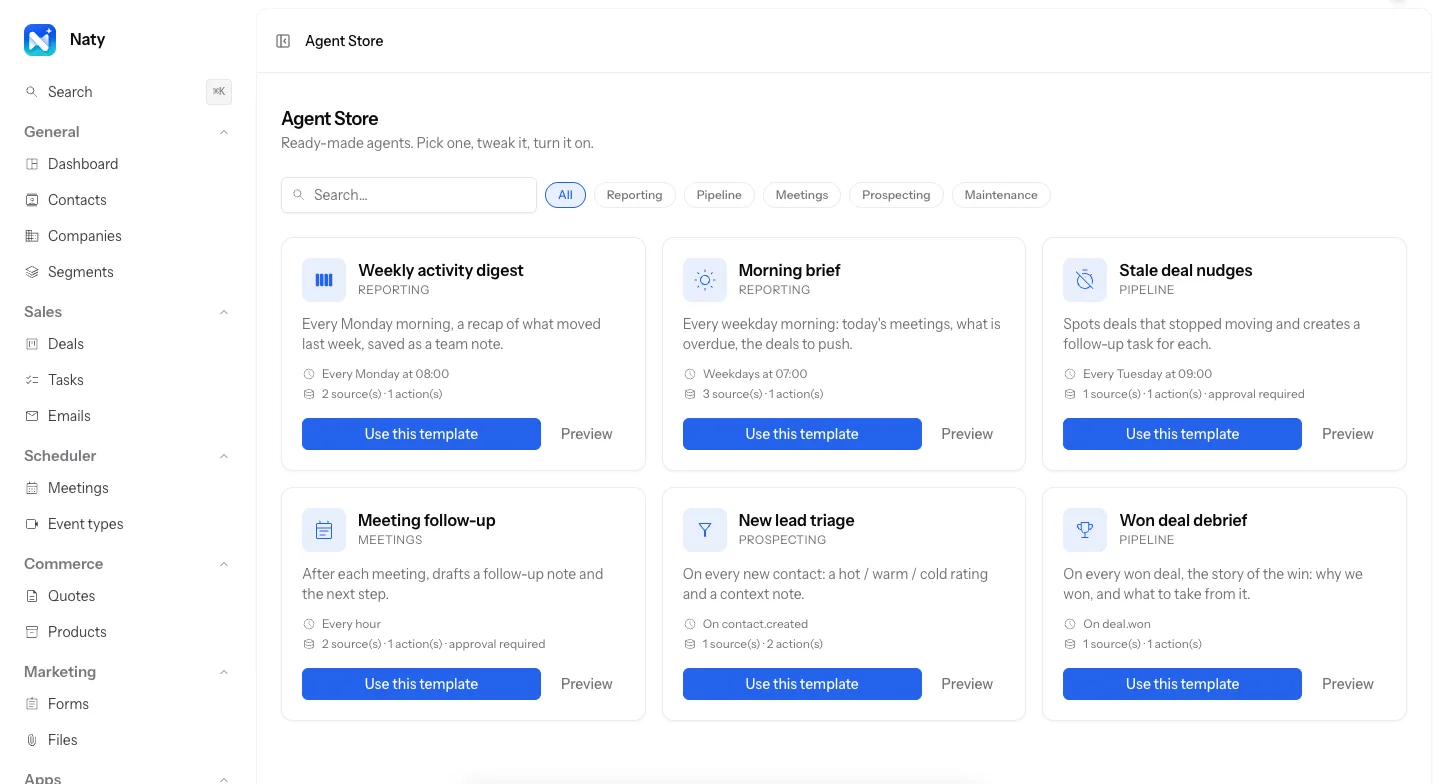
Each prebuilt agent is a starting point: install it, then edit its trigger, sources, prompt and actions like any agent you build yourself.
01Weekly activity digest
Monday 08:00
Optional
02Morning brief
Weekdays 07:00
Optional
03Stale deal nudges
Tuesday 09:00
Required
04Meeting follow-up
Every hour
Required
05New lead triage
contact.created
Optional
06Form qualification
form.submitted
Optional
07Monthly pipeline review
1st of the month
Optional
08Data hygiene
Weekly
Optional
09Won deal debrief
deal.won
Optional
10Next step after a task
task.completed
Optional
Seven guardrails.
Human approval, per agent, with a queue and an expiry.
Separate permissions: approving is not configuring.
Action cap: a maximum number of writes per run.
Useful runs only: no data, no model call.
Full history of context, response, actions and errors.
Duplicate lock: one execution at a time per agent.
Model and budget, set agent by agent.
08Business model
Naty is sold per user per month, excluding tax, with AI agents bundled into every plan as a credit allowance rather than sold as an add-on. Prices are shown in euros and in Pacific francs. Annual billing saves 20%, and a two-year commitment takes off a further 10%.
Ama
The float · single user
€19
per user / month, billed yearly · €24 monthly · ≈ 2,300 F
Va'a
The canoe · from 2 users
€44
per user / month, billed yearly · €55 monthly · ≈ 5,250 F
Moana
The ocean · from 2 users
€79
per user / month, billed yearly · €99 monthly · ≈ 9,400 F
Switch from another CRM
The importer reads HubSpot, Pipedrive and Salesforce exports, plus clean CSV files.
No lock-in
Monthly plans can be cancelled in the interface, and all data can be exported at any time.
Guided onboarding
A one-time €1,200 package: data import, pipeline setup, three agents, two trainings and 30 days of follow-up.
Prices as listed on naty.io, excluding tax.
09Our relationship
Naty was built through Garan's Startup Studio program. We co-founded the company alongside the founding team and have carried the product from the first line of code to market, providing technical execution, product design and go-to-market support from day one.
Co-founded
Involved from day zero, shaping the vision, the positioning against US-centric suites and the structure of the company.
Product and design
A modular workspace of eleven apps, an agent builder that explains itself in plain language, and an approval flow anyone on the team can use.
Engineering
Our engineering team built the product from the ground up: the CRM core, the agent engine with its queue and run logs, permissions down to API keys.
Growth and operations
Ongoing support across product and growth as the company scales, with bridges to the rest of the portfolio such as the Beeving integration.
Explore more from our portfolio
Whether you're building, investing, or looking for a strategic partner, we'd love to talk.